Bernadette Soubirous, Superstar
Be ruthless.
No actual Blessed Virgin Mary appears to Bernadette Soubirous at the cave of Massabielle outside Lourdes 11 February 1858. She is Bernadette’s creation, and that is the miracle, the artistic construction of the Lady in White, her costume, that blue sash, her rosary white beads on a gold chain, her fragrance, the skillful composition of the Lady’s discourse, delaying, deferring, the issue of her identity, the suspense mounting, and then the socko declaration, the one that astonished Pius IX: “Que soy era Immaculada Councepciou,” a master stroke.
Unlike the other saintly children, their lives and stories given over to ideological causes in the civil wars of the Church, Bernadette owns her story, every detail, and she vigilantly guards its singular integrity. The prosecutor, the commissioner, the medical examiner, each, at different times, interrogates Bernadette and presents her with a transcript of the session, which Bernadette calmly refuses to sign. Not true. Not true. Not true. I said more beautiful, not as beautiful. The Commissioner is astonished. What insolence, this twit of a guttersnipe. How is it she scans or hears the text, catching all the smudges and smears of her actual statement, this calm young girl who has yet to pass her Catechism examination, has not yet received First Communion? Bernadette did not escape the civil wars. She was a soldier in Pius IX’s Catholic army, prayed the rosary, respectfully obeyed Sister and Father. She would give Pius IX, and his Church, an immense far reaching gift in the sixteenth visitation: “Que soy era Immaculada Councepciou,”, divine confirmation of the 1854 papal decree, and yet Bernadette, for all her many submissions to religious authority, still stands apart, she has her own complex cause, the Vision, which she serves singlemindedly all her life.
I first encountered Bernadette in the Rialto Theater, Kaukauna, Wisconsin, in 1943. We walked in ranks from south side St. Mary’s across the bridge to north side Kaukauna where the Rialto had arranged a special afternoon viewing. As we approached the theater, here came the troopers from Holy Cross, north side Catholic country. We sat on separate sides. Tough nuns patrolled the aisles. No merriment allowed. Franz Werfel’s 1941 novel, The Song of Bernadette, I would much later learn, simply took Bernadette at her word. The Blessed Virgin actually appears in the 20th Century Fox film version, luminous, silvery, in the flesh, played by Linda Darnell, a film star who was also (reportedly, she denied it) the producer Darryl F. Zanuck’s mistress. A soulful soft spoken Jennifer Jones, too old, too tall, would win an Oscar for her performance. For a long time Jennifer Jones was my Bernadette of Lourdes.
Bernadette is fourteen. She is barely literate. At ten she contracted cholera, suffered its wrenching flux, almost died, and now suffers the consequent stress induced ailments, heart palpitation, asthma. The impoverished Soubirous family, mother, father, sisters, brothers, live rent free in a single room, formerly a jail cell. Andre Sajous, a sympathetic embarrassed relative, owns the building. He and his family live on the top floor. The Soubirous family live on the ground floor, the basement. It is called the Cachot, which is how Bernadette, under police interrogation, resolutely identifies her home. “I live in the Dungeon.” Once middle class, operators of a mill, the enterprise failing, the Soubirous family has tumbled into this social pit in Lourdes, reached the misery of their final home address. Bernadette has grown up in prison. Eating, washing, eliminating, fecal, urinary, in this close space, could put steel into a child’s soul. Every day is a search for food and fuel. Nights are cold and damp. Oldest child, awake, asthmatic, hoarsely breathing, beginning to panic, hating to make this disturbing noise in the crowded single room, Bernadette confronts the terms of her plight, understands the situation. No significant medical treatment is available. She is alone with her affliction. In that black hole of a basement flat, she suffers her labored breathing and its impact on the others.
Just fourteen, recently sexual, changed or changing, those long cold nights in the Cachot, stifling coughs, Bernadette must ponder her several probable futures. Summer 1857 she was sent to live with Marie Aravant Lagues, formerly Bernadette’s wetnurse, to tend lambs, to do farm labor, to look after Madame Lagues’s five children. So she would earn her daily bread and breathe the better air in Bartres, a nearby village. She was supposed also to attend the parish school and take instruction in the Catechism. Fall passes, often not at school, sheepherding in the high meadows, Bernadette considers her situation. She is living effectively in a state of peonage, her needful parents offloading her, farming her out to these inhospitable relatives, Madame Lagues once her “nanny,” now her mistress, coldly determined to get maximum value for Bernadette’s residence. Madame Lagues was also to tutor Bernadette in the Catechism. The text is in French. Bernadette is just learning to read and write French. She speaks the Bigorre dialect of the Pyrenean Occitan language. She desperately wants to make her First Communion, to join her friends and classmates at the communion rail, but she must first pass an examination in French on the French Catechism. Religious instruction in the evening is tense, Madame Lagues impatient. Bernadette struggling, losing her place, forgetting the answer, winter comes on, and still Bernadette promptly fails the test. Frustrated, probably exhausted by her day labor, Madame Lagues, at one point, hurls the catechism across the room, the book in the air, pages fluttering.
“You will never learn anything.”
Shortly thereafter Bernadette returns to the Cachot, at her own insistence, walking the frozen five kilometers from Bartres to Lourdes, no doubt to the dismay of her surprised parents and the disappointment of her hungry siblings. Bernadette twice sent word to her parents to come and take her home. No response. Her mother, for good reasons, had sent her to Bartres for healthier living conditions, better diet, and, no doubt, for her own respite, Bernadette the sick child from the beginning, the one she couldn’t nurse. Bernadette will not stay any longer in Bartres. She will not accept Madame Lagues’s dismissive judgment. If she was going to pass her catechism test and achieve her First Communion, she needed better instruction.
Here, in action, we see the emergent thinker, self determining, turning abruptly back to unwelcoming Lourdes, to its grade school, her best chance to pass the test and enter the church community, to get into its language and literature. First Communion opens a door to this wider world. It is a Catholic child’s first adult act. Girls got some piece of finery. Several Sisters and two curates will fail to get Bernadette through her Catechism examination. God is speaking to her in the grotto and she is flunking the Catechism test, repeatedly, throughout the sequence of her Visitations. Finally her frustrated pastor, Father Dominique Peyramale, writes “Pass” in the blank on the form and visionary Bernadette goes forward to the communion rail.
Walking those cold five kilometers back to Lourdes, Bernadette must realize she is between rejecting mothers, understanding their different plights. She knows what marriage sounds like. Her mother is continually pregnant, child after child brought into that single room. In the black hole of the Cachot, Bernadette’s heart flutters. She can’t breathe. Drudgery and disease, the future. Her social situation is hopeless. She’s a grade behind in school (cholera) and still missing classes, first sheepherding, lamb tending, in Bartres, now at home doing child care and house work. She needs to pass her catechism test and must now realize she has a memorization problem. She’s blocked, can’t say what Extreme Unction is, forgets the necessary statement of the Trinity, how it must be said, forgets the constitution of the Eucharist. It remains a mystery, her resistance to the Catechism. After the Visitations, placed in the Hospice School taught by the Sisters of Charity, Bernadette’s writing and reading skills immediately improve.
10 February 1858.
Back in Lourdes, Bernadette must be at once desperate and resolved. Her native intelligence quickly brings her to a dead end. She has no worldly future in Lourdes, or anywhere. Stunted in her growth, with heart and lung issues, Bernadette must dread the question of marriage and family. She might be a nun, but at the moment she can’t pass her catechism examination. No way out. She is a doomed character in French naturalist fiction.
Emile Zola, the grand master of such fiction, would write a perplexed admiring account of Bernadette Soubirous in his Three Cities: Lourdes, Paris, Rome (1894), looking for context and influence. He thought Bernadette got language and folklore in Bartres at church and village socials. There were several literary priests in the village, one of them Madame Lagues’s brother, a frequent visitor, who brought church news to his sister and her assembled family. Zola could also see the larger picture at play in Bernadette’s imagination: ancient Roman Lourdes, its temple to the water gods, medieval castle on the mount over the Gave, these Pyrenean foothills still murmurous with pre-Christian deities, Bernadette, her mind busy, sheepherding all day in the high hills above Bartres.
Zola’s critical judgment of Bernadette’s Vision, that it is “hallucination,” must be wrong, as her Vision, set forth, is tightly crafted, fifteen pledged visitations (fifteen chapters), with three extra visits, eminently reasonable in its statement, serving the Pope’s cause, affirming his authority, always inside proper Marian discourse, and yet the seer is obviously improvising, finding a way, discovering what comes next, Bernadette, juvenile genius, managing a complex visionary structure.
10 February 1858
Bernadette also has piety, which lets her escape the decree of Zola’s fiction, that she suffer and die in the black hole of the Cachot, end of story. She lives in a Catholic France still afire with the several Marian devotions preached by St. Louis de Montfort, who, in the first decade of the 18th century, suddenly and brilliantly revealed a hidden Blessed Virgin. His The Secret of Mary (1712) gave the Church a new devotion, a new field of study, Mariology, a new set of confraternities and sodalities. He recharged the rosary, redirected public and private prayer to the Immaculate Heart of Mary, to the Immaculate Conception, to the Blessed Virgin Mary, using the chain, the beads, and the crucifix. Montfort’s rosary becomes the central prayer in Roman Catholicism, almost supplanting the Eucharist as the object of religious attention, squeezing the bead, stroking it, the prime device, available, portable. Bernadette’s rosary is knotted cord and black wooden beads.
The Blessed Virgin, held back by the Apostles, not a factor in Protestant thinking, emerges from the shade, comes to rally her beleaguered Catholic France staggered by Reformation and Revolution. There are numerous apparitions in Catholic Europe, Jesus favoring the Latin Catholics, France, Italy, Spain, Portugal. In France the Blessed Virgin appears to Catherine Laboure in Paris (1830) and then to Maximin Giraud and Melanie Calvat, two young shepherds, outside La Salette (1846) in southeastern France. Zola supposes Bernadette heard accounts of the apparitions at La Salette while at church socials in Bartres: white raiment, roses at the feet, and the portentous message: “repentance, repentance, repentance.” Also a demand for the daily praying of the rosary. Bernadette does not venture forth without her rosary. Outside
Bartres, sheepherding, lamb tending, she tells her beads, thinking about her situation. In the black hole of the Lourdes Dungeon, at night, the rosary is her lifeline.
Desperate thinking and constant prayer combine in her intelligence. Desperate thinking tells Bernadette she needs a miracle. No parent or relative, no priest or nun, at this moment, sees her, understands the emotion building in her, a frustrated power of creativity wanting to break out, to do something. Dominique and Louise Soubirous worked long hours every day. A neighbor remembered seeing Bernadette at prayer in an empty church, her baby brother glued to her hip. Much later, a saintly Sister of Charity in the convent at Nevers, Bernadette would write in her notebook: “I was nothing, and of this nothing God made something great.” Desperate thinking at fourteen compelled Bernadette to see “this nothing,” to take its full measure, yet she had piety and the hope that God would intervene and do something, break into the awfulness of Bernadette’s “nothing” life. So she prayed the rosary, over and again, hailing Mary, ardent incantation.
God would indeed make Bernadette great, lift her in a single day from total obscurity to worldwide fame. The shy little girl in the back row of the parish school would now calmly command her selected stage, where she kneels, dominate the set, grotto and niche of Massabielle, focused, not disturbed by the throng of pilgrims and spectators crowded around her, doctors taking her pulse, skeptics burning her with a candle, not disturbed, entranced. Jean-Baptiste Estrade, local tax collector, fascinated spectator, got close to Bernadette to register her expressions: “Her face and her gestures reproduced all the phases of a conversation. By turns laughing or serious, Bernadette showed approval with a nod of her head, or seemed herself to be asking questions.” The substance of this observed exchange was not recorded, Bernadette not saying what the Blessed Virgin said that made Bernadette laugh.
11 February 1858
Thanks to Commissioner Dominique Jacomet’s prosecutorial bullying, his looking for evidence of fraud, we have steadfast Bernadette in the police record very specific in her description of the person she first saw in the grotto. “I saw a beautiful young girl with a rosary on her arm.” White raiment, blue sash. Jacomet wants more detail. Bernadette remembers seeing a curl of the young girl’s hair escaping her veil. I still get a chill considering this errant curl of hair. It must be of the Blessed Virgin’s devising, to permit it, to rehumanize her appearance, ever so slightly awry, as she gently dazzles Bernadette. A frustrated Jacomet prepares the transcript and Bernadette rejects it. Infuriated, Jacomet threatens her with prison. Just fourteen, speaking Bigorre, her Pyrenean dialect, not yet having passed her catechism
test, probably a local scandal, hitherto a silenced young girl, pitiable, Bernadette says: “So much the better! I shall not cost my father less, and in prison you’ll come and teach me my Catechism.” Bernadette has mouth, little sovereign ironies escaping her pious parlance, flashes of temper, here proletarian contempt for the municipal police. Her father, Dominique Soubirous, falsely charged with the theft of a plank, did time in the city jail. She was the thief’s daughter.
Here she is, late afternoon, in cold damp Lourdes, at the city dump, looking for scrap firewood. Toinette, her younger sister, and Jeanne Abadie, neighborhood friend, are with her, but off to the side, scavenging on their own. Something has been building in Bernadette, an impatience, a desire to precipitate, to do something, to have something happen. She’s taking off her wooden shoes and her stockings in order to wade a channel, is arrested, experiences an aura, prelude to seizure, a roaring in her ears, everything in the field of vision utterly still, an uncanny movement of wind, a flash of light, golden radiance, and here she is, Aquero, in Bernadette’s dialect, “that one,” a resplendent supernatural person in luminous church clothes.
This first visitation is everything, though nothing is said. Bernadette prays the rosary, Aquero silently observing, counting the beads on her white and gold rosary. The rosary is Aquero’s assurance she is not a Pyrenean fairy, not a cave ghost, but Christian and holy. She can’t pray the rosary with Bernadette. She merely counts the beads Bernadette prays, and this is, one might suppose, an early clue set forth about the identity of Aquero. The non-designation gives Bernadette space and time to ponder, to calculate, to consider, what Aquero would do, what she would say. Bernadette will not prematurely set off police alarms with radical statement. The silence also establishes an air of restraint, the calm of two ‘sensitives’ silently communicating,
supernatural Aquero tactfully establishing herself as nonthreatening in this encounter. She appreciates the diligence of Bernadette’s rosary prayer. Aquero next recedes into the cave, disappears, Bernadette on her knees, stunned. The immediate significance of the first visitation, not lost on Bernadette, is that Aquero has chosen her from among the many receptive young girls in Lourdes, has seen her, noticed her, work drudge, slow pupil, has recognized her native genius, that Bernadette Soubirous, currently flunking her catechism examination, is nonetheless capable of expressing a Vision. Nobly dressed in white raiment, a delicate gentlewoman, roses at her feet, Aquero will speak, without condescension, to Bernadette in Bigorre, Bernadette’s peasant/proletarian dialect.
Bernadette creates the Blessed Virgin, brings her forth from the cave. She knows she needs a miracle and this is it, an empowering Vision, a character, an agent, at first simply Aquero (Bernadette), a beautiful young girl, later Notre Dame (Bernadette) sending crisp directives to the local clergy. I want a chapel. I want a procession. A rosary fanatic, Bernadette has been hailing Mary for a long time, and now, that flash of sunlight in the cave, here she is. In Lourdes: Body and Spirit in the Secular Age (1999), Ruth Harris deals exhaustively with the central question of what is in Bernadette’s mind as she falls to her knees at the entrance to the grotto, what knowledge of Catherine Laboure’s visions, of the apparition at La Salette, what diverse information from her Pyrenean folkloric tradition, framing the figure, Aquero, informing its composition. Zola was also stopped at this verge. How does Bernadette, just fourteen, barely literate, a damaged, wounded girl, construct that first visitation, describe a supernatural person
with such delicacy, begin to make serious compositional decisions, the first being the
apparition does not announce her name? After the excitement of the first two encounters, Bernadette decides on a sequence of fifteen visitations. All this, the Vision entire, is channeled through Bernadette’s still-not-named Blessed Virgin, who will only visit her in this public space, not in her dreams, not in her daily discourse.
Hallucination can’t explain the artful craft of Bernadette’s performance and story. Visionary tradition (Aquero) will require Bernadette to kiss the ground, to eat a weed, to muddy her face. Visionary tradition (Aquero) will let Bernadette dramatically turn and confront the aghast crowd, deliver admonition: repent, repent, repent. Visionary tradition (Aquero) will tell her three secrets, will give her a secret prayer. It will also tell her she will suffer much physical pain and die young. It will give Bernadette a fountain of curative water, but of no use to her. Other visions have done as much in different Latin countries, brought up springs, performed miracles. Bernadette brought to the Vision, to her Vision, a certain artistry, the device of Aquero’s not identifying herself, avoiding the question with a polite smile, the puzzle of that reticence, also a certain theatrical mise-en-scene, a mobile Aquero coming up close upon Bernadette, a cousin kneeling next to Bernadette, inside the bubble of supernatural presence, oblivious. Bernadette’s Vision involved her in logics, in consequences, which she tried to engage. Lourdes, and very soon, Catholic Europe, France especially, wanted to know who is the person in the apparition. Bernadette can’t say because Aquero will not herself say who she is. Aquero wants a chapel.
She wants a procession. A skeptical Father Peyramale says Aquero must first tell us who she is and then make the rosebush in the frozen grotto bloom. Bernadette relays the messages. Aquero simply ignores Father Peyramale’s demand and repeats her desire.
Bernadette had the fabled slip, could induce an aura, could go into a trancelike concentration, slip free of responsibility, Bernadette a passive receptor, a transmitter, a medium, always, pretty much, on script when she later told and retold her story. She was free and powerful inside that story. Police interrogators and medical examiners could not break into it, find cause. She was simply faithful to the integrity of her Vision. Everything Aquero said fit beautifully into Marian piety. Bernadette was happily installed in Marian piety, telling beads every spare moment. Her monster egotism (artist, performer, saint) found a protected expression in Marian discourse, and she was prudent in her usages. We have the spare often acerbic public speech of Aquero. We almost have the witty playful serious Aquero in private conversation, onlookers reading Bernadette’s animated face, eyebrows up and down, eyes widening, lips parting, silent laughter. Here, too, early on, is the great supernatural Blessed Virgin Mary, still in guise, asking for fifteen visits, saying to raggedy Bernadette, “por favor.”
Any brilliant fourteen-year-old French girl could say such things: pray for sinners, kiss the ground, drink at the spring. Bernadette had fifteen episodes to name Aquero, a mounting suspense, as Bernadette no doubt struggled with the great issue of the Vision, the final leap. Can Bernadette say “I am the Blessed Virgin Mary,” hit us all with the visceral impact of that statement? This is how close we are to Jesus. Aquero has simply to say who she is. Fifteen episodes, and Bernadette couldn’t do it.
1944, Rialto Theater, Kaukauna, Wisconsin, fourth grade, St. Mary’s Elementary School, a special afternoon screening of The Song of Bernadette, Linda Darnell, playing Our Lady of Lourdes, steps up to her mark and announces her name. “I am the Immaculate Conception.”
I remember my disappointment. I wanted the real thing, the personal name. Instead I had this dry uninteresting abstraction that had nothing to do with the body before me, lissome Linda Darnell, nobly dressed, the blue sash. In the fourth grade, sitting in that dark theater among my somber classmates, I was certain Bernadette had made a mistake, compromised what had been such a great visionary device, using the other non-name, “Beautiful Lady,” further loading the concept of her identity. There is nothing to see in the Immaculate Conception. It is not a name. Hence, to some extent, the non-name is an aversion, Bernadette dodging inside a convenient abstraction, a mystery, still refusing to say the insane I am the Blessed Virgin Mary.
Bernadette asks four times, who are you. At last Aquero makes an exaggerated gesture with her arms, lifting them high, then clasping her bosom, as if the naming took some divine effort, cost her a pang. She gives us the statement and is gone.
Que soy era Immaculada Councepciou.
It was the key that opened the door. Bernadette later said she had no idea what it meant. When she reported the name to Father Peyramale, big words she didn’t understand, he was astonished and convinced. How did Bernadette Soubirous, this barely literate girl who had yet to pass her catechism examination, achieve this stroke of genius, give us not the expected name, a new name. He wrote that evening to Bishop Bertrand-Severe Mascarou Laurence of Tarbes and Lourdes. Father Peyramale had demanded Aquero name herself and now she had, speaking directly to him, Bernadette merely the conveyer of a name she did not understand. Que soy era Immaculada Councepciou ultimately addressed the entire Catholic Church. “As Pius IX said, I was born without original sin. I am nearest divinity, the prime intercessor.” This concept had to be nailed down, Catholic near worship of Mary justified. Retreat to Mary, to the rosary, to miracle, it was the anti-Protestant, anti-Modernist strategy of the 19th century popes, especially IX and X, and here she was, Holy Mother of God, standing in a grotto in the south of France. Bishop Laurence, who already had a thick file on Bernadette Soubirous, promptly took over the management of Bernadette’s Vision, much to Father Peyramale’s dismay. News of the declaration went straight to Pius IX who was thrilled.
How did Bernadette come upon this opportune title, Immaculada Councepciou? She would know the titles in the Litany of the Blessed Virgin Mary, Mystical Rose, Morning Star, Queen conceived Without Original Sin, this last near the end of the Litany. Bernadette has already decided Aquero will not say her personal name. Bernadette must now choose among titles, and
Thursday, March 4, she has yet to choose, yet to hear what her Aquero will say.
The fifteenth and final visitation did not deliver the expected climax. Twenty thousand people, spectators and pilgrims, candles flickering, were in jostling unruly attendance at the grotto wanting something to happen.. The French Army, in full dress uniform, kept order, making way for Bernadette as she approached Massabielle. It is, any way you look at it, a star turn, Bernadette Soubirous, escorted to the grotto, kneeling at the site, looking up, the first ten rows of audience leaning in, pressing forward, intently reading Bernadette’s varied expression, noting a strange light that seemed to inclose her head, perhaps a halo. But nothing happened. Bernadette did not report a message from the Beautiful Lady. They had a long private conversation. Then Bernadette got up from her knees, her escort forming, and left Massabielle. Twenty thousand people stood about, some praying the rosary, others discussing the event. The withered rosebush did not burst into bloom. They did not hear a celestial voice. They saw the cold black rock of the niche where ostensibly the Beautiful Lady was standing. Holy Fortnight was over, the Vision shut down without a final grand revelation. The Fifteenth Vision was numerically complete, Aquero leaving without a farewell.
Three weeks passed, Bernadette praying and pondering, Aquero herself strangely silent. A Lourdais mother, Croisine Bouhort, immersed her dying two-year-old son, Louis, in the ice cold spring at the grotto for a long fifteen minutes. Next day little Louis was up and at play. Lourdes understood Bernadette was not done. Municipal authorities did not control the situation at Massabielle. Bernadette Soubirous, just fourteen years old (it can’t be said enough), lowly insignificant daughter of a convicted felon, pious, demure, commanded each visitation, arrived and departed on her terms. She would defy a full array of imposing male authority: mayor, police chief, medical examiner, state inspector, simply holding to the strength of her conviction, her belief in the integrity of her Vision. Still, Aquero did not speak, did not give Bernadette her personal name, and the March days passed. Bernadette had to report something strong, something empowering, to Catholic France, or her Vision effectively fails, doesn’t deliver. If the intense faith of a believing multitude isn’t there to charge the miraculous spring, might its healing power subside? If Bernadette’s Vision was to be established, authorized, enshrined, Bernadette had first to satisfy Father Peyramale’s demand for the name and a blooming rosebush in the grotto at Massabielle. She was up against his formidable skepticism. Only certified Visions have duration.
Thursday, March 25, up early morning, before sunrise, roused, she remembered, by an “inner insistence,” Bernadette went to the grotto. She had the answer to her question. She asked four times: “Would you be so kind as to tell me who you are?” Aquero, also called “Mademoiselle,” has come close to Bernadette, they’ve calmly said the rosary, “Mademoiselle” counting the beads, they’ve exchanged tender remarks, and then the question and then the answer. Bernadette ran, it is said, from the grotto to Father Peyramale’s chambers, shouting it out, over and again, “Immaculada, Immaculada.” She had her Eureka! moment. Aquero, that “inner insistence,” that “something within me,” did not fail her.
It is arguably a fair compromise, a gift to the Catholic Church for its protection and maintenance, divine affirmation of a controversial papal decree, and an escape hatch for Bernadette from the direst direct blasphemy of full disclosure.
I am the Immaculate Conception is not the same as I am the Blessed Virgin Mary.
“Immaculada, Immaculada” is a brilliant move and it is also, so I thought in the fourth grade in 1943, false, wrong. The charming, beautifully dressed person whose conversation is witty and wise, who has an arch view of “the priests,” who never mentions Father Peyramale’s name, has certainly an adult human name, Miriam, Mary, to make her appearance perfectly personal. She is not this abstruse theological reconditioning of Mary’s human status, a concept hard to imagine, as there is no human face or voice to the Immaculate Conception. Apparition is face and voice. That is the thrill of it. “Immaculada, Immaculada” turns Bernadette’s Vision over to the Church, to Bishop Laurence in Tarbes, who almost immediately purchases all the available terrain around Massabielle. Bernadette rang the right bell with the clunk of that name. Her pastor and bishop were certain (from sexist and classist presumption) Bernadette did not herself possess the words, Immaculate Conception. These words were not from Bernadette. They were for Father Peyramale and Bishop Laurence. Final proof of Bernadette’s honesty depends on their idea of her ignorance.
The Diocese of Tarbes and Lourdes begins to invest heavily in Bernadette’s Vision, to build a shrine, organize the pilgrimage, manage hospitals, establish an archive. Famous French people arrive at the Gare de Lourdes. In nearby Biarritz Empress Eugenie gives a dose of Bernadette’s spring water to her ailing tubercular son, the Prince Imperial, little Napoleon IV, and next day he is better, no longer ailing. Bernadette is a sensation in France. In her creation and performance of the Vision, she is free in her choices and decisions, strong in her action, refusing a police order to stay away from the grotto, demanding a church and processions. She is a quietly charismatic person who has produced a religious spectacle without the consent and assistance of her pastor and bishop. Her life in Lourdes was dramatic. Lunatic visionaries began to show up at the Grotto, doing pantomimes. She had imitators, notably Josephine Albario and Marie Courrech, neighborhood girls, classmates at school, who were also on their knees conversing with a Beautiful Lady. Bernadette’s Vision had let loose a volatile energy of faith and disbelief in Lourdes. Suspicious reporters from the liberal press talked to naïve Lourdais looking for fraud and scandalous behavior. Bernadette was, after all, the daughter of a criminal living in a squalid overcrowded tenement flat. Her destitute demoralized parents barely counted as protectors.
To secure their principal asset, the purity of their product, so to speak, Bishop Laurence and his principal advisors remove Bernadette from Lourdes and her beloved Grotto. There is to be no occasion for additional visitations, no encouragement of a cult following, no temptation from the world, no funding or regular contribution. Bernadette is sent to the Convent of St. Gildard in Nevers, 500 miles from Lourdes, to become a Sister of Charity. Chastity, Poverty, Obedience. Once there Bernadette is under strict surveillance. Mother Superior Marie Therese Vauzou is famously skeptical of Bernadette’s holiness, constantly wounding Bernadette’s warm heart with caustic criticism. Mother Superior looked for signs of a secret ego, a secret pride, well concealed, and never found one. It was there, of course, the monster ego of Bernadette’s early adolescence, an insistence that she do wonders, but always beautifully put into prayer, into the exercises of holiness. At St. Gildard she wrote in her prayer book: “I was nothing [10 February 1858], and of this nothing [11 February 1858] God made something great.” The asthmatic girl who slept on a straw mattress in the dank cold Cachot is now the saintly star invalid at the Convent of St. Gildard, tubercular, doomed, her bed in the infirmary white plush and lace
under a canopy, holy pictures placed about, physicians attending.
Bernadette’s Vision at first is like a Calder mobile, a lot of space and silence, yet breathing, in motion, eighteen suspended instances, some spine and frame, all this dangling in the air at Massabielle before the weight of the fateful annunciation is added and the Church seizes the Vision for its uses. See Ruth Harris’s Lourdes: Body and Spirit in the Secular Age (1999) and Therese Taylor’s Bernadette of Lourdes, Her Life, Death and Visions (1999) for the new comprehensive interpretation of Bernadette’s astonishing career in French sanctity, one that is attentive to questions of gender and national politics. The Sanctuary of Our Lady of Lourdes, chapels, churches, spring and grotto, flies Bernadette’s rosebud flag of total resistance to unrepentant insolent Protestantism and radical Modernism throughout the latter half of the nineteenth century. Management of the shrine is royalist, right wing, racist. Bernadette has nothing to do with the Domain, so the shrine complex is called, having signed away her property rights, so to speak, in 1858, with Immaculada Councepciou, and next submitted to priestly capture, took those vows: chastity, poverty, obedience.
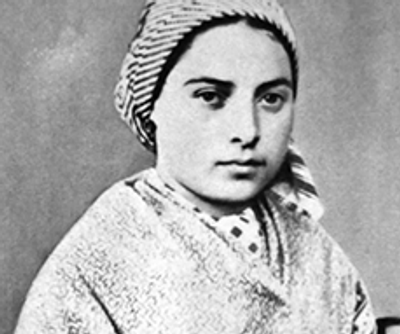
The Sisters of Charity give Bernadette, in her thirty fifth year, a beautiful death, all the amenities. She gives the Sisters her miraculous dead body, still only somewhat decomposed, at rest in the glass coffin exposed in the Chapel of St. Gildard. Here she is, April, 1879, just laid out.
Regard the visage.
She looks like Aquero as the stunted slow Pyrenean girl described her in 1858.
Mister Neil and the ellgee
They were good friends, kind to us, better established in London, she a keen Germanist out
of Oxford, he a genial American banker, a Wisconsin lad, as I was. We went to the theater
together, had a pint at the local pub, socialized. We spent a pleasant weekend in Little Milton,
Oxfordshire, a very pretty English village, guests of their Oxford University friends who had a
stone cottage just outside the village. She was on a postdoc, her subject, Holocaust literature,
Theresienstadt, memoirs. It was a load of grief to bear working on the documents. Straight cut
brown hair, horn rimmed glasses, no makeup, she calmly met your gaze, her English loud harsh
Ulster English. She was laser smart, had four languages, and she was very funny, an Irish
storyteller, facetious, droll. The banker stood about proudly beaming while she held forth. He
drove the car that took us places.
At some point she began calling us Mister Neil and the ellgee (LG, little girl). I amiably
accepted this identification. My partner at that moment in my life proudly stood five feet, one
and a half inches, so she said. Perhaps, I thought, Ulster saw the actual four foot, eleven
person inside the pretend five footer, and was humorously calling her to its truth, ellgee. I
thought I was outside the gibe, though Mister Neil, I recognized even then, was slightly off. We
all happily coexisted in our Shepherds Bush life. Her Ulster mother would send us home baked
wheaten bread, and of course we had Ulster butter to spread on it.
She was also a professing evangelical Christian, born again, and she had that alert
proselytizing glint always somewhere in her gaze, a Bible verse at the ready. I saw it in other
exchanges, in the glib flow of academic chatter, she would interpolate a verse, cleverly put, but
never insist, the chatter going on. She never spent a verse on me. We talked about other
things. I assumed she recognized I was a vigilant foot soldier in the Enlightenment Army,
formidably defended against verses, and that was true, to some extent, but there were other
reasons for her disinterest in my spiritual life, as, very much later, I came to realize.
She threw that brick. “Mister Neil and the ellgee.”
At first the brick had no specific gravity. It had no slam, just merest bristle. She had funny
names for other people. It was a year of adventures and satisfactions. I was fairly impervious
to digs and slights. Soon we all went our separate ways. Centuries change. I’m sweeping the
kitchen floor in my house, and the brick, the complete brick, abruptly lands, slam, “Mister Neil
and the LG.” It is a pornographic title. I’m posted as a pedophile. The abbreviation conceals
and highlights the true state of affairs, the little girl, her nonfamilial relation to the man. It is what Ulster thought considering us, she was testifying, even as we all got along famously, everyone appreciating Ulster’s sharp Belfastian wit.
I hold the brick in my hand, weighing it. A lot of bad shit is still in this brick, a load of
Christian rectitude, and I must say it now hurts, the impact of that long ago hurled rectitude. Not
the charge itself, but the malevolence of that Christian imperative to denounce me, Mister Neil,
named, not the ellgee, as the responsible person. Mister Neil. I could be on a poster in the
Post Office, “also known as Mister Neil.” Neil is my first name. LG is not a gibe at my partner’s
height. Mister Neil is an insult brick to the back of my head, a slam. Why didn’t I confront Ulster
on the thrust of her lurid meaning? Take her aside to say: “I do not appreciate this
characterization for many good reasons which I won’t explain. I don’t want to hear you say it
again.” I didn’t protest. I didn’t at that early event feel the full heft of the brick. In the
sophisticated company we kept in London, pairs and teams were better terms for the amorous
friendships the blessed sixties had made possible.. My teammate was reading William Blake. I
was on my first sabbatical. I was in the British Museum adrift in the Egyptian and Assyrian
parlors. It was one of my best years, fairly free of darts and irks, I thought.
I know a thing or two about brickbats and stings. I’ve carefully studied George Herriman’s
Krazy Kat (1910-1945). I know what is in the brick Ignatz Mouse hurls at Krazy Kat. Elias
Canetti’s “The Command” from Crowds and Power is my authority on the sting, what we feel
after the outrage of a command, after the hit (kluck) of the brick.
I put Ulster’s gnarly brick on the table. Is there any innocence in her statement, any
exculpatory factors, that would lighten the obvious and certain meaning of the brick? Ulster
was an Oxford Germanist, herself a Northern Ireland storyteller. Each weighted word was
certainly knowingly selected by her, which is what, to some extent, I still resist accepting, the
calculated choice of “Mister Neil.” We were good friends, I thought. She was everywhere
admired for her kindness and respected for her keen wit and analysis. Gospel verses, I guess,
compelled her to judge me. Did she expect me to respond to the insolence of her caption:
Mister Neil and the LG? Now I remember conversations, Ulster at some point saying: “What
does Mister Neil think?” With a certain edge of irony. I was cold to her work on the Holocaust, I
can’t say why, its certainties, its solemnities, left me speechless.
We did not intellectually connect.
That is packed inside the brick along with my frivolity on religious topics, regaling friends and
guests with interesting stories from the Summa Theologica, St. Thomas’s definition of mortal sin
immensely liberating, applauded. Now I hear the grinding of Ulster’s teeth inside her grim smile.
She’s pretty sure St. Thomas never said how difficult it was to commit a mortal sin. She sees
what a sly menace I am, libertine, liar, cynical relativist, and how I might easily be stifling the
LG’s spiritual life. Also, what’s this, a notation, a suspicion. Ulster’s Wisconsin banker husband
and I have cordial relations and that’s it. His patrician Milwaukee Wisconsin, my proletarian
Kaukauna Wisconsin, worlds apart. I was hard edge. He was smooth as butter. The note
says: class envy.
The action in the quartet was between Ulster and the ellgee. They hung out together, went
to museums, to lectures, while I stayed home, smoked hash, watched Morecombe and Wise on
the telly, thinking about the book I was writing. No doubt God and Nature figured largely in their
conversations. No doubt Ulster laid verses before the ellgee. Which ones, I wonder. God and
Nature were in fact big subjects for Mister Neil and the ellgee. The ellgee despised Mr. Neil’s
casual interest in Roman Catholicism. She was raised a devout Baha’i, her parents eminent
leaders in the Buffalo Baha’i community, and though the ellgee was, strictly speaking, a
covenant breaker, an apostate, she remained a Baha’i, on her terms. How could I profess to
cherish and respect Catholicism and yet so easily deride and mock its beliefs and mysteries?
How could I be so arbitrary, so hypocritical, and what’s more, how could she live with such a smug nihilist? She hated the Catholic word, apostate, and coldly rejected it as the name for our
team, my humble suggestion. There was a lot I didn’t choose to see that brightening spring in
London.
So here it is, unpacked, to the best of my ability, emptied, a dead brick, a comprehended
insult. Ancient stuff, pieces and particles. I’m on the wrong side at the Battle of the Boyne,
Ulster saw that, Catholic Jacobite, tribally opposed to Protestant sides, at that very moment in
time detesting the Protestant politics of Ian Paisley in Northern Ireland, a fiery born-again
Presbyterian minister/politician, a stick in the eye of every Roman Catholic, practicing and nonpracticing. Ulster was a liberal progressive person, a true Christian, not a Paisley partisan. I
was a kind of lapsed Catholic, an atheist Roman Catholic, a Marxist Roman Catholic, admitting
the genius of the Church, the power of its statement. We weren’t at any barricade, yet we were
opposed, she was doing God’s work, I was not. Worse, from a strictly stated Presbyterian
standpoint, Mister Neil was doing the Devil’s work.
Ancient stuff, pieces and particles, this Catholic and Protestant thing, yet heavy in its quiet
constant insistence, two sunk ships which you never see, yet there they are, submerged, be
aware of these mossy wrecks as you start and steer toward the point in your explanation or
discussion. I am mindful of Pope Leo X, probably gay, a Medici pope, in his private parlor
relaxing among his paintings and sculptures, enjoying his sumptuous papal life, and it is
October 31, 1517, Martin Luther is nailing his 95 Theses to the Castle Church door in wintry
Wittenberg.
Hard edged Protestantism, born again Christianity, so resolute, so certain, still rebukes the
“church of Rome,” as Ian Paisley had it, our relaxed sensual Roman Catholic Church. Leo X’s
response to Luther’s Theses, Exsurge, Domine (1520), plaintively reminds Brother Martin that
Jesus anointed Peter and established the papacy. Protestants almost immediately win the
battle, wrest true authentic Christianity from the Roman Catholic Church, a pent-up flood of
sanctifying grace pouring into the nations of northern Europe. Protestant Christianity has a
driver Catholicism can’t match, can’t even find, the second baptism, being born again, that leap
of faith. Catholics can’t make that leap of faith. Catholics meet God in a big church on Sunday
sitting quietly in the pews. Catholics do not proselytize.
I was up against all that in London, the Reformation, Ulster’s rectitude, and didn’t at the time
realize it. Our team, I thought, was strong, for all the theological wrangling. I now remember
weeks when the wrangling didn’t occur, I’d be allowed to babble on, the ellgee quietly not
listening. I was hopeless, spiritually speaking. She needed quiet time to reconsider her
commitment. I had nothing to offer in matters concerning the spirit. I had ironic scholarship and aesthetic appreciation. I always had “spirit” in brackets, arrested. Ulster, born again, secure in
her faith, had the glory of a new life to offer my discontented teammate.
All this in Ulster’s brick.
One last thing remains, a little black bag tucked into a pleat. In it a splinter from some alpha
brick, its three last letters, and when I see what it is, I can only flinch and groan, as it is the most
feared word in a woman’s sexual lexicon, a word so powerful it can only be used by women.
Men do not have access to it, can’t say it in a manly way, so they are deprived of the right to
counter charge. To defend the behavior only gets you deeper in the mire of disgusting. Short of
violence, there is no answer. It is a woman’s brickbat, crisply definite, a final utterance. Ulster
loaded her big brick with animosities and grievances, which I’ve tried to disarm, but here is a
double delayed petite bombe, and it goes off as I open the bag to examine it. ick is the remnant
lettering on the brick splinter. ick is the killer. Ulster has that last fling of feminist Christian
scorn. Ick reduces the original pornographic title to its basic element.
To have this petite bombe go off in my study just at this moment in American cultural history,
ick, as a term, as a meaning, now as big as Moby Dick, the White Whale, ick, the whole gross
anatomy of male sexual behavior, ick, the member exposed, ick, what a coincidence, what a
sweet last revenge for Ulster, loaded in another time zone, not presently thrown, just arriving.
Ick.
Somewhere men are constructing an apt rebuttal.
